



If you have ever searched for a stitch gun for clothes mold supplier and received quotes ranging from $3,000 to $30,000 for what looks like the same product, you are not alone. A duvet fastener — also called a quilt clip, duvet clip, or comforter fastener — is typically a two-piece assembly: a base and a snap button. At first glance, it seems simple. So why do quotes vary so dramatically?
The answer almost always comes down to one thing most buyers overlook: the number of sliders required for undercuts. A stitch gun for clothes with a snap-fit locking mechanism almost always has undercuts — features the plastic cannot release straight from the mold. Each undercut requires a slider, and each slider adds thousands of dollars to the tooling cost.
Throughout this guide, we use “stitch gun for clothes” as the consumer-facing term for the duvet fastener — the two-piece plastic clip that holds a comforter in place inside its cover. If you are a buyer searching for duvet fastener mold, quilt clip mold, or comforter fastener tooling, this guide applies to you.
We are an injection molding factory that produces stitch gun for clothes molds and custom plastic parts. In this guide, we break down exactly where your tooling money goes, why a single-cavity prototype mold costs a fraction of a multi-cavity production mold, and how to avoid the hidden costs that inflate quotes.
Before we dive into mold costs, it helps to understand how the end user actually applies your product. This is critical because the user experience dictates the product design, which in turn dictates the mold complexity.
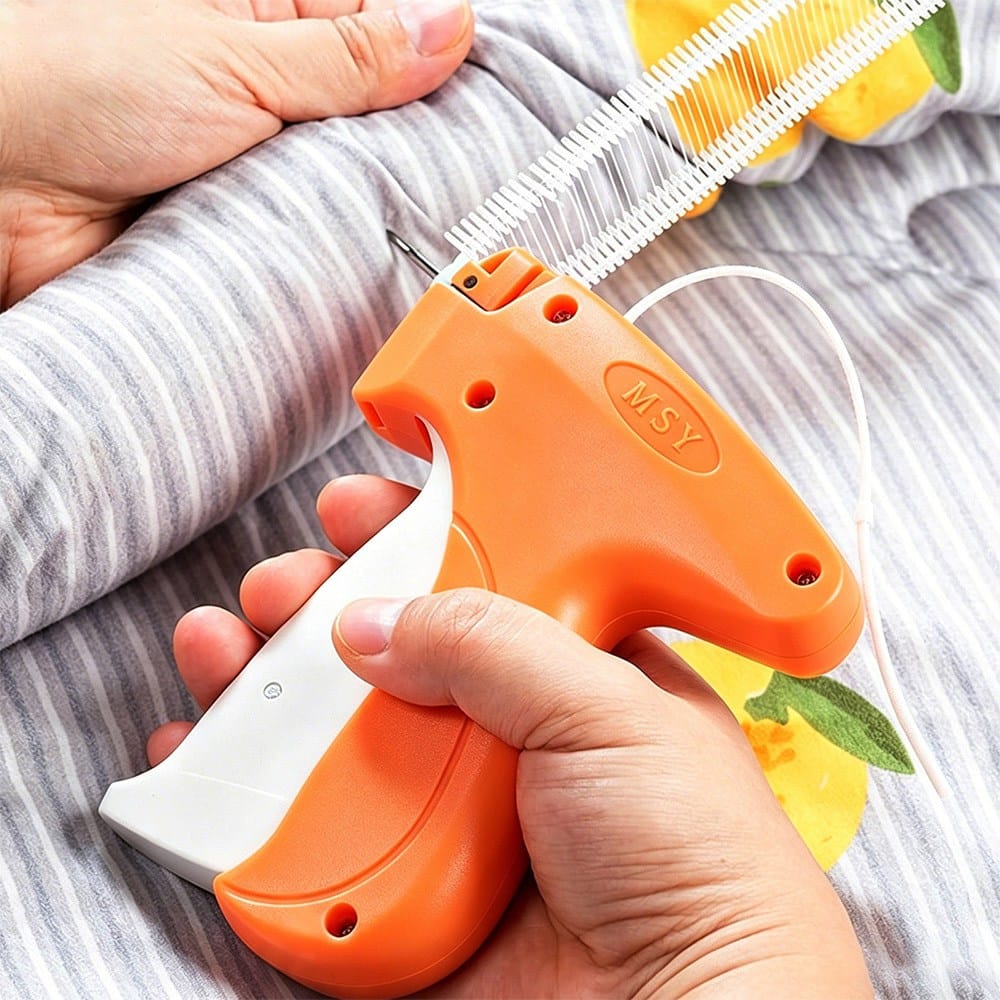
As shown in our factory sample (see image), the upgraded stitch gun for clothes works with an automatic card gun. If you have ever used a sewing gun or a clothing tagging gun, the operation is remarkably similar, but much faster. Many people ask how to use a micro stitch gun for delicate fabrics; the principle is the same — align, insert, and snap.
Here is the simple 1-2-3 process for applying a duvet fastener:
This "one-second fix" is fast, efficient, and labor-saving. Unlike traditional tag guns for retail use that use plastic barbed pins for retail labels, a stitch gun for clothes uses larger, softer two-piece clips that won't damage your bedding. The ergonomic design of the gun itself — often made using co injection molding to create a hard core with a soft-touch grip — ensures that users can secure an entire king-size duvet in under a minute without hand fatigue.
A duvet fastener typically consists of two components:
Some designs also include a release mechanism — a button, tab, or magnetic unlock feature — that allows the user to separate the two pieces without damaging the fabric. This is where mold complexity explodes. A basic snap-fit duvet fastener might have 2–3 undercuts. A quilt clip with a push-button release can have 5–8 undercuts across both parts.
For comparison, think about a stitch gun for clothes or a sewing gun: these are handheld tools with complex internal mechanisms, and their molds are expensive for the same reason — many undercuts and moving parts. A cloth stitching gun tagging gun or tag guns for retail use also have intricate snap-fit assemblies. A duvet fastener is simpler, but the same mold design principles apply.
A duvet fastener mold quote is not a single number. It is the sum of several cost categories. Here is the standard breakdown for a two-plate injection mold:
| Cost Category | Share of Total | What It Covers |
|---|---|---|
| Design & Engineering | 10–20% | DFM analysis, mold flow simulation, 3D mold design |
| Mold Steel Material | 20–30% | Mold base, cavity/core steel, standard components |
| CNC & EDM Machining | 40–60% | Rough machining, precision CNC, micro EDM, polishing |
| Assembly & Testing | 10–20% | Mold assembly, T1–T3 trial runs, part inspection |
Source: industry-standard mold cost structure
The key insight: steel is rarely the biggest cost. Machining time — CNC milling, EDM, polishing, and fitting — accounts for 40% to 60% of your quote. This is why two quotes for the same duvet fastener can differ by 40%: the cheaper one may skip mold flow analysis, use fewer trial rounds, or quote thinner steel.
For a stitch gun for clothes mold specifically, the machining cost is driven by how many sliders and lifters are needed to form the undercuts. A simple two-plate mold with no sliders costs the least. Every slider adds machining, fitting, and future maintenance points.
The single biggest decision that affects your duvet fastener mold cost is cavity count. Here is how the pricing scales:
| Mold Type | Typical Price (China) | Mold Life | Best For |
|---|---|---|---|
| Single-cavity prototype | $1,500–$5,000 | 1,000–10,000 shots | Low-volume testing, product prototyping |
| Low-volume production | $5,000–$15,000 | 100,000–300,000 shots | Small batch production, market testing |
| Multi-cavity production | $15,000–$50,000 | 300,000–500,000 shots | Mass production |
| High-cavity production | $50,000–$100,000+ | 500,000–1,000,000+ shots | High-volume small parts |
Source: verified mold pricing data
A duvet fastener is a small part with high market demand. Most customers who are serious about mass production choose a 4-cavity or 8-cavity mold. Here is the tradeoff:
More cavities mean a higher upfront tooling investment but a lower per-part price and shorter cycle time. In fact, a 1-out-of-4 mold typically costs about 2 times a single-cavity mold, and a 1-out-of-8 mold costs about 3 times — but the per-piece cost can drop by 40%–60%. At high annual volumes, the extra tooling cost pays back within months of production.
For a duvet fastener with both a base and a snap button, you typically need two separate molds — one for each component. Some factories use a family mold that produces both parts in the same tool, which saves cost compared to two separate molds.
This is the section most buyers wish they had read before requesting quotes.
A duvet fastener almost always has undercuts. The snap button needs a barbed or mushroom-shaped head to lock into the base. That head cannot be formed by a simple two-plate mold — the plastic would be trapped. The mold needs a slider (also called a side action) that moves sideways to release the undercut before the part is ejected.
Here is the real cost impact:
For a duvet fastener with a push-button release, you may need sliders on both the base and the button. That is potentially 4–6 sliders across two molds, adding $8,000–$30,000 to your total tooling investment.
This is why some stitch gun for clothes mold quotes are $8,000 and others are $25,000. The cheaper quote may have been based on a simplified design with fewer undercuts. The more expensive quote accounts for the actual geometry of your product.
Design tip: Sometimes a 2–5° draft angle change or a small geometry adjustment can eliminate one or two sliders entirely. A good mold factory will flag this during DFM review before steel is cut.
Steel grade affects both mold cost and mold life. Here is a practical guide for duvet fastener production:
| Steel Grade | Cost Level | Mold Life | Best For |
|---|---|---|---|
| P20 (pre-hardened) | Lowest | 100,000–300,000 shots | Small batch, market testing |
| 718 / 2738 | Medium | 300,000–500,000 shots | Standard production |
| H13 / S136 (hardened) | Highest | 500,000–1,000,000+ shots | High-volume mass production |
Source: steel grade cost and life data
For a duvet fastener with annual volume under 100,000 pieces, P20 steel is sufficient. For high-volume production exceeding 500,000 pieces per year, H13 hardened steel is the better investment. A P20 mold costs 30%–50% less than H13 upfront, but will wear out faster.
In terms of raw material price, P20 typically costs around $8–$15 per kg, while H13 costs around $17–$30 per kg. The price difference between P20 and H13 for the same duvet fastener geometry is typically $3,000–$8,000.
The relationship between MOQ (minimum order quantity) and mold cost is straightforward:
For duvet fasteners, the market is typically high-volume. If you plan to sell through retail channels or e-commerce platforms, you will likely need 100,000+ pieces per year. In that case, a 4-cavity or 8-cavity mold with H13 steel is the right investment.
Here is a real-world breakdown of how two factories can quote the same duvet fastener at vastly different prices:
| Cost Factor | Low Quote ($8,000) | High Quote ($25,000) |
|---|---|---|
| Cavity count | 1 cavity | 4 cavities |
| Sliders | 1 slider (simplified design) | 4 sliders (full undercut support) |
| Steel grade | P20 | H13 hardened |
| Trial rounds | T1 only | T1 + T2 + T3 |
| Mold flow analysis | Not included | Included |
| Surface finish | Standard EDM | SPI B2 polish |
| Expected mold life | 100,000 shots | 500,000+ shots |
The low quote is not necessarily a bad quote — it may be perfectly adequate for a small test run. But if you plan to produce duvet fasteners at scale, the high quote will save you money in the long run through longer mold life, fewer production stops, and lower per-part cost.
Q: How much does a stitch gun for clothes injection mold cost?
A: A single-cavity prototype mold for a simple duvet fastener starts around $1,500–$5,000. A production-ready multi-cavity mold with sliders for the snap-fit undercuts typically ranges from $15,000 to $50,000, depending on cavity count, steel grade, and the number of sliders required. A full set (base mold + button mold) will cost more than a single-part mold.
Q: What is a stitch gun for clothes?
A: A stitch gun for clothes is a handheld tool that uses plastic fasteners to quickly attach fabric layers together. It is commonly used to secure duvet covers to comforters, fix hems, attach buttons, and close seams. The plastic fasteners it uses — duvet fasteners — are typically two-piece snap-fit clips: a base and a button that lock together through the fabric.
Q: Why do sliders increase duvet fastener mold cost so much?
A: A duvet fastener with a snap-fit locking mechanism has undercuts — parts of the shape that cannot be pulled straight out of the mold. A slider is a moving piece of the mold that slides sideways to release the undercut before the part is ejected. Each slider requires additional machining, fitting, and maintenance. Each slider adds $1,000–$3,000+ to the mold cost.
Q: What is the difference between a single-cavity and multi-cavity mold for duvet fasteners?
A: A single-cavity mold produces one duvet fastener part per injection cycle. A multi-cavity mold produces 2, 4, 8, or more parts per cycle. Multi-cavity molds cost more upfront but reduce per-part cost and shorten production time. For high-volume duvet fastener production, a 4-cavity or 8-cavity mold is the standard choice.
Q: How long does it take to build a duvet fastener mold?
A: A simple single-cavity prototype mold takes 2–4 weeks from design freeze to T1 sampling. A multi-cavity production mold with sliders and hardened steel takes 4–8 weeks. Complex molds with hot runner systems and extensive T1–T3 validation can take 8–12 weeks.
Q: What is the MOQ for a custom stitch gun for clothes mold?
A: There is no fixed MOQ for the mold itself — you can order a single mold. However, the MOQ for the finished duvet fasteners depends on the mold type. A prototype mold may be economical for as few as 1,000 pieces. A production mold typically requires a minimum order of 10,000–50,000 pieces to justify the tooling investment.
Q: Can you make a duvet fastener mold with a hot runner system?
A: Yes. A hot runner system adds $3,000–$20,000 to the mold cost but eliminates cold runner waste and shortens cycle time. For high-volume duvet fastener production with expensive resins, a hot runner system can pay for itself within months. For small-batch production, a cold runner is more cost-effective.
Q: What is co injection molding and can it be used for duvet fasteners?
A: Co injection molding (also called sandwich molding) injects two different plastic materials into the same mold — a skin material and a core material. This technique can reduce material cost by 15%–22% by using recycled or lower-cost plastic in the core while maintaining a high-quality surface. For duvet fasteners, co injection molding is rarely necessary because the parts are small and the material cost per piece is low. However, if you are producing duvet fasteners in very high volumes and want to use recycled PP for the core, co injection molding is an option worth discussing with your mold factory. It is also commonly used for the stitch gun for clothes housing itself, where a hard core and soft-touch grip are desired.
Q: How do I know if my stitch gun for clothes design needs a slider?
A: If your stitch gun for clothes fastener has any feature that cannot be released by pulling the mold straight open — such as a snap-fit barb, a side hole, an internal thread, or a mushroom-shaped head — it needs a slider or lifter. The best way to find out is to request a DFM (Design for Manufacturability) review from your mold factory before you commit to tooling. A good DFM review will identify every undercut and estimate the slider cost before steel is cut.
Q: What is the difference between a slider and a lifter in duvet fastener molds?
A: A slider moves sideways (perpendicular to the mold opening direction) to release an undercut on the side of the part. A lifter moves at an angle to release an undercut on the inside of the part. For duvet fasteners, sliders are more common because the snap-fit barbs are on the outer surface of the button. Lifters may be needed if the base has an internal locking ring.
A stitch gun for clothes mold is not a commodity product. The price you pay reflects the engineering complexity of your specific design. The two biggest cost drivers are cavity count and slider count for undercuts. If your duvet fastener has a simple snap-fit design with minimal undercuts, a single-cavity P20 mold can cost as little as $3,000–$8,000. If your design has a push-button release with multiple undercuts on both the base and the button, expect to invest $20,000–$50,000 in a multi-cavity production mold.
The smartest approach: request a DFM review before you finalize your design. A good mold factory will tell you which undercuts can be eliminated, which sliders are unavoidable, and how cavity count affects your total cost of ownership. That conversation can save you $10,000 or more in tooling mistakes.
If you are ready to discuss your stitch gun for clothes or duvet fastener project, contact our injection molding team for a free DFM review and tooling quote.
No account yet?
Create an Account