




Meta Description: Discover why home cooks and professionals are ditching electric grinders for the rolling knife sharpening technique. Compare heat generation, metal removal, and factory sourcing specs with Daqida.
Electric knife sharpeners have been the default "easy" answer for years. Push a button, pull the blade through, done. But a growing number of cooks — and knife makers — are ditching them. The reason isn't nostalgia. It's metallurgy.
Electric sharpeners are essentially miniature grinding machines. They pull your knife through abrasive slots spinning at high speed, grinding away metal to create a new edge. The problem is that they remove too much metal, too quickly, and at the wrong angles. This thins the blade, weakens edge integrity, and generates enough heat to alter the steel's temper — essentially making an expensive knife soft and unable to hold a sharp edge for long.
That heat issue is the quiet killer. High-speed grinding friction raises the edge temperature, and at a certain point the steel's crystalline structure changes. The blade loses hardness permanently. You can sharpen it again and again, but it never holds.
There's also the control problem. Electric sharpeners offer little to no precision. Every knife has a unique edge angle that should be maintained. Electric models use preset angles that can't adapt to different blade geometries, leading to improperly sharpened edges. And because the grinding happens inside a slot, you can't see what's actually being removed.
Professional kitchens have noticed. Chefs rarely use electric sharpeners on their primary knives. The lack of control and aggressive nature of most electric models are unsuitable for high-end blades. Professionals prefer manual methods — including rolling sharpeners — for the precision they offer.
There's also a practical rhythm to it. The rolling motion is quiet, tactile, and almost meditative. No motor noise. No metal dust spraying into the air. No wondering whether the blade is overheating inside a sealed slot. You feel the diamond bite, hear the pitch change as the edge refines, and stop when the burr disappears. That feedback loop is something electric sharpeners simply can't provide.
This is where the rolling technique changes the equation.
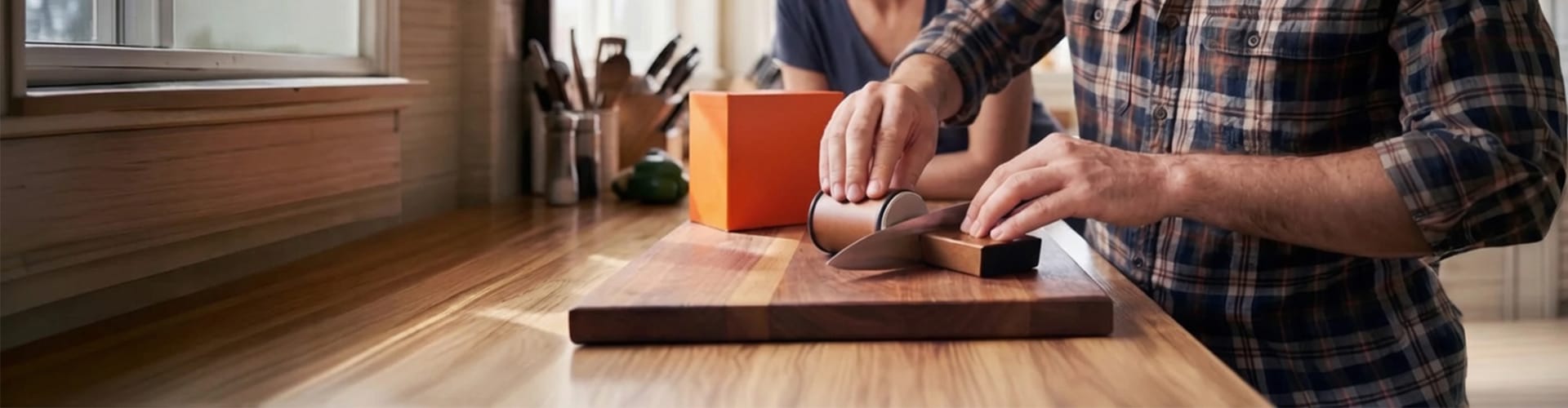
A rolling sharpener uses a magnetic angle block to lock the knife at a fixed angle — typically 15° or 20° — while you roll a diamond disc along the edge. The key difference is that you control the speed, the pressure, and the duration. The abrasive touches the steel at a consistent angle every pass, but the motion is slow enough that heat never builds up. Diamond abrasive grinds precisely with minimal steel removal.
The result is a refined, durable edge that's better for the knife's long-term health. Electric models might feel faster, but the rolling method creates a superior quality edge that lasts longer.
For most home cooks, the rolling technique hits a sweet spot: easier than learning freehand whetstone sharpening, gentler than electric grinding, and consistent enough that you don't need to think about angles. It's not about being anti-technology. It's about choosing the right technology for the job.
| Factor | Rolling Sharpener | Electric Grinder |
|---|---|---|
| Heat generation | Minimal — slow, controlled motion | High — friction alters steel temper |
| Metal removal | Precise, minimal | Excessive, thins the blade |
| Angle control | Locked by magnet, consistent | Preset, can't adapt to blade geometry |
| Feedback | Tactile — feel and hear the edge refine | None — sealed slot hides the process |
| Long-term effect | Preserves knife life | Shortens knife life |
| Noise & mess | Quiet, no metal dust | Motor noise, airborne particles |
If you're buying a rolling sharpener — or sourcing them for retail — these are the specs that actually matter:
If you're exploring custom builds or private label manufacturing options like a Rolling Knife Sharpener – Aluminum body or a rugged Rolling Knife Sharpener – Stainless Steel Body, ask for the magnet grade, the diamond spec, and the certifications. Then order samples from a few factories and sharpen 50 knives on each. The one that still cuts cleanly is the one worth your money.
🏭 DAQIDA Factory Qualification Certificates & Injection Molding Expertise
As a professional direct source factory, DAQIDA masters advanced plastic injection molding processes, DFM optimization, and strict production discipline backed by our official qualification certificates:
• Explore our full manufacturing capabilities via the DAQIDA Product Catalog ➔
Avoid common mass-production pitfalls like shrinkage and warping. Partner with DAQIDA for professional OEM and ODM manufacturing solutions built on precise DFM analysis, stable process control, and rigorous factory quality standards.
No account yet?
Create an Account