



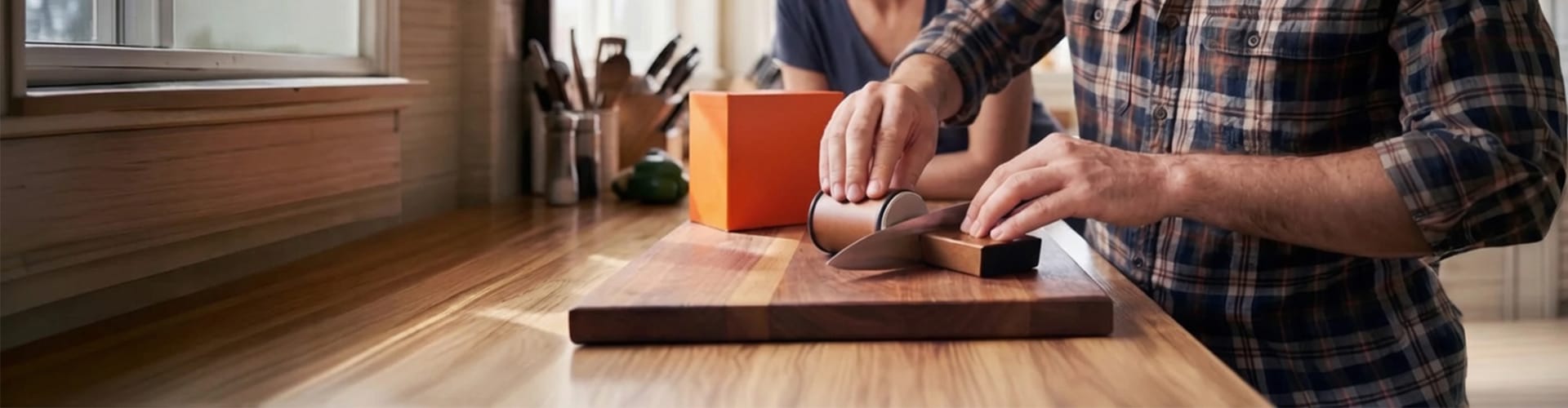

Meta Description: Learn how to use a Rolling Knife Sharpener step by step—and how it compares to a traditional whetstone. Angles, passes, polishing, maintenance, and what home cooks should know about the Rolling Knife Sharpener.
I used a whetstone for years. I still own three. So when I say a Rolling Knife Sharpener is easier, I'm not saying it's better at everything.
But for most home cooks, the Rolling Knife Sharpener wins at the thing that matters: getting a sharp knife without a 20-minute ritual.
A whetstone gives you the best edge possible. That's why chefs use them. But you have to hold a consistent angle by hand, soak the stone, build a slurry, feel for a burr, and flatten the stone later. One bad stroke and you've rounded the tip of a $150 knife.
A Rolling Knife Sharpener trades ultimate edge for consistency. The magnetic angle block locks your knife at 15° or 20°. You roll a diamond disc along the edge instead of scraping it through an electric slot. The Rolling Knife Sharpener is faster than a whetstone and gentler than an electric machine.
Here's the honest comparison:
| Factor | Rolling Knife Sharpener | Whetstone | Electric Sharpener |
|---|---|---|---|
| Learning curve | Low — angle is fixed | High — months to master | None |
| Setup time | None | 5–15 min soak + setup | None |
| Sharpening time | 3–5 min | 10–20 min | 1–2 min |
| Angle consistency | Locked by magnet | Depends on your wrist | Fixed but aggressive |
| Metal removal | Controlled | Minimal | Excessive |
| Mess | Wipe clean | Water, slurry, cleanup | Metal dust |
| Best for | Most home cooks | Enthusiasts, pros | People who don't care about knife life |
That table tells the whole story. The Rolling Knife Sharpener sits in the middle: easier than a whetstone, gentler than an electric machine.
A Rolling Knife Sharpener has two main parts.
The rolling unit. One side is a #400 diamond disc for coarse grinding. The other is a fine ceramic or polishing disc for finishing. Look for an industrial diamond composite base. Cheap Rolling Knife Sharpeners shed grit and wear out fast.
The magnetic angle block. This is the key to the Rolling Knife Sharpener. It has two sides — usually 15° for Japanese and fillet knives, 20° for Western chef's knives. Silicone end caps protect the blade. Strong magnets hold the knife steady. Weak magnets mean a loose knife and a bad edge.
When in doubt, choose 20° on your Rolling Knife Sharpener. It's more durable and forgiving.
Here is the core process. This is the part most people search for: how to use a Rolling Knife Sharpener without overthinking it.
| Step | What You Do | Passes | Why It Works |
|---|---|---|---|
| 1. Secure the knife | Place the blade flat on the magnetic angle block. Pick 15° or 20°. It should snap into place. Nudge the handle—if it slides, reposition. | — | The Rolling Knife Sharpener removes angle guesswork. Your wrist can't ruin the edge. |
| 2. Coarse grind | Put the diamond side against the edge. Roll back and forth with steady, even pressure. Don't force it. Use the Sharpie trick if unsure. | Dull or chipped: 20–40. Maintenance: 8–12. Heavy use: 15–20. |
The #400 diamond disc repairs dullness and minor chips fast. |
| 3. Fine polish and deburr | Flip to the fine disc. Roll with lighter pressure along the edge. | 5–10 | This removes the weak burr and refines the edge to a cleaner, sharper finish. |
| 4. Wipe and test | Wipe the blade with a damp cloth. Dry it fully. Test on a ripe tomato or printer paper. | — | If it pushes or tears, polish more. If it glides, you're done. |
That's how to use a Rolling Knife Sharpener. Four steps. No soaking. No flattening. No guesswork.
Keep your Rolling Knife Sharpener's diamond disc clean. A pencil eraser is the easiest tool. Rub it against the disc to lift embedded metal particles. If it's really clogged, wash with warm water, a drop of dish soap, and a soft brush. Dry completely. Never put your Rolling Knife Sharpener in the dishwasher.
A whetstone needs flattening every few uses. A Rolling Knife Sharpener doesn't. That's one less maintenance chore. With proper care, the diamond disc on a quality Rolling Knife Sharpener lasts 3–5 years at home.
If you're sourcing Rolling Knife Sharpeners for retail or private label, the category is growing fast—but quality varies wildly. Check these before you commit:
Order samples from at least three factories and sharpen 50 knives on each Rolling Knife Sharpener. The one that still cuts cleanly is your partner. If you're a wholesaler or brand owner looking for custom Rolling Knife Sharpeners with your logo and packaging, reach out to our factory team. We can share sample kits and pricing from vetted production lines.
If you enjoy sharpening, a whetstone gives you the best edge. If you just want a sharp knife every day without the ritual, the Rolling Knife Sharpener wins. For most home cooks, the Rolling Knife Sharpener delivers consistency without the learning curve. And a sharp knife you actually maintain is better than a perfect edge you never bother to create.
🏭 DAQIDA Factory Qualification Certificates & Injection Molding Expertise
As a professional direct source factory, DAQIDA masters advanced plastic injection molding processes, DFM optimization, and strict production discipline backed by our official qualification certificates:
• Explore our full manufacturing capabilities via the DAQIDA Product Catalog ➔
Avoid common mass-production pitfalls like shrinkage and warping. Partner with DAQIDA for professional OEM and ODM manufacturing solutions built on precise DFM analysis, stable process control, and rigorous factory quality standards.
No account yet?
Create an Account