




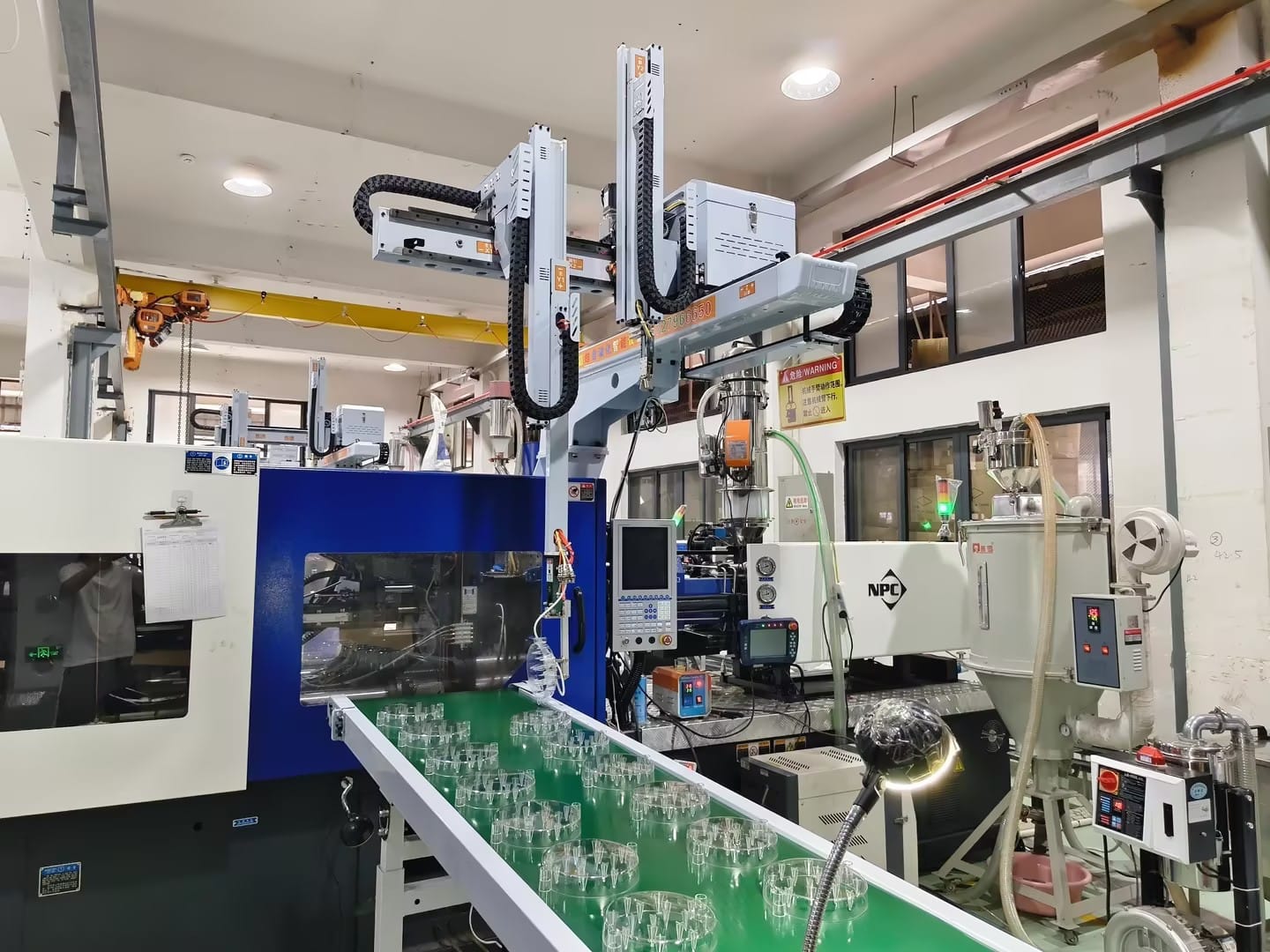
Plastic manufacturing services cover a broad set of commercial activities, not a single standardized service. Broadly, they can be divided into two major directions: mass injection-molding production, and plastic material fabrication.
Many cross-border buyers search terms such as plastic manufacturing services, oem plastic manufacturer, or plastic manufacturing companies near me with inconsistent expectations. Some buyers want ready-made finished goods for resale; others only need a factory to produce parts according to their drawings.
It is important to clarify basic definitions before contacting suppliers:
No supplier can satisfy every demand. A factory good at large-volume industrial parts may not be suitable for small-batch consumer goods, and vice versa. The core of supplier selection is matching your own project conditions with the supplier's business positioning.
When screening plastic-related suppliers, buyers can judge suitability from these neutral dimensions, without simply judging "good or bad":
In the global market, plastic-processing participants can be roughly divided into several categories, each with reasonable application scenarios:
All the above types occupy indispensable positions in the industrial chain. There is no absolute superiority or inferiority, only suitability for different project needs.
Note: This table is for reference only, summarizing the common operational characteristics of different market players including 10 North-American manufacturers plus DAQIDA. Actual service capability of each enterprise shall be subject to official consultation.
| Comparison Item | Inteplast Group | Tessy Plastics | PTI | Millwood Inc | JM Eagle | Piedmont Plastics | Penn Color | Bemis Manufacturing | Polymershapes | Five Star Plastics | DAQIDA |
|---|---|---|---|---|---|---|---|---|---|---|---|
| Headquarters | Livingston, NJ, USA | Skaneateles, NY, USA | Holland, OH, USA | Vienna, OH, USA | Los Angeles, CA, USA | Morrisville, NC, USA | Doylestown, PA, USA | Sheboygan Falls, WI, USA | Charlotte, NC, USA | USA | Yiwu, China |
| Core Business | Packaging films & plastic compounds | Precision injection molding & assembly | Packaging design, testing & production | Industrial pallets & logistics packaging | PVC / HDPE engineering plastic pipes | Plastic semi-finished goods distribution | Color masterbatch & pigment additives | Molded consumer & industrial plastic parts | Plastic material distribution & CNC processing | Industrial-grade plastic component processing | Ready-stock consumer goods + OEM / ODM injection molding |
| Core Process / Technology | Film extrusion, compounding | Precision injection molding, clean-room assembly | Packaging molding & testing | Structural foam & pallet molding | Pipe extrusion | Distribution + CNC cutting/bending | Color matching & compounding | Injection molding, large-part molding | Distribution + CNC machining | Industrial injection molding & tooling | Injection molding, in-house mold development, consumer-product design |
| Scale Positioning | Very large, multi-plant | Large, multi-site | Large | Large | Very large | Large distributor network | Large | Large | Large distributor network | Mid-size industrial | Mid-size, flexible small-batch |
| Ready-made consumer finished-goods | Limited | Rare | Limited | Rare | Rare | No (distribution only) | None | Limited | No (distribution only) | Industrial-focus | Multiple self-developed stock SKUs |
| In-house consumer-trend product development | No | Customer-spec only | Packaging-only | No | No | No | Raw-material formula R&D | Limited | No | No | Yes — trend-driven hit-product development |
| Typical MOQ | Very high | Very high | High | Very high | Very high | Variable (distributor) | High | High | Variable (distributor) | High | 100 pcs (stock) / 1,000 pcs (custom) |
| Custom OEM / ODM capability | Limited to existing lines | Yes, for large clients | Custom packaging only | Mostly standard items | Standard pipes only | Material fabrication service | Color formula customization | Limited to large clients | Material cutting service | Limited industrial custom | Full-service in-house mold development |
| Available compliance certifications | Industrial standards | Industrial & medical standards | Packaging-related standards | Industrial logistics standards | Engineering pipe standards | Depends on raw material | Raw-material industry standards | Market-specific certifications | Depends on raw material | Industrial-grade | CE, FDA-related reports for applicable consumer products |
| Primary target customers | Large packaging enterprises | Large medical & industrial OEM brands | Major consumer-goods packaging buyers | Factory logistics & bulk shippers | Construction & water-supply contractors | Industrial end-users buying semi-finished stock | Other plastic manufacturing factories | Large established distributors | Industrial customers purchasing plastic blanks | Industrial equipment clients | Amazon sellers, retailers, small-batch importers |
| Suitability for cross-border consumer resellers | Poor | Poor | Poor | Poor | Poor | Poor | Poor | Moderate | Poor | Poor | Good |
Many buyers confuse plastic manufacturing services with plastic fabrication companies, which easily leads to wrong supplier selection.
Brief judgment rule: If you need hundreds or thousands of identical complex-shaped plastic consumer goods, injection molding is more reasonable. If you only need several sets of simple-structure prototypes, you can consider plastic fabrication.
Before sending an inquiry to any plastic-manufacturing-service provider, sort out the following information, which can greatly improve quotation efficiency and avoid expectation deviation:
Q1: Why is the MOQ gap of different plastic manufacturers so large?
A: MOQ is affected by mold amortization, raw-material minimum batch, production-line switching loss and factory operation mode. Large MOQ does not mean the factory is bad; it means its cost system is built for large-batch orders. Small-batch projects will face higher comprehensive costs at such suppliers.
Q2: If I search for plastic manufacturing companies near me, can I definitely get small-batch services?
A: Local suppliers can realize face-to-face communication, but they also follow their own positioning. Many local manufacturers are also oriented to large industrial orders. Location cannot guarantee low MOQ or consumer-goods-oriented services.
Q3: Is OEM better than ODM?
A: There is no absolute good or bad. If you have mature drawings and samples, OEM can accurately realize your design. If you only have functional ideas and lack design capacity, ODM is more suitable. Choose according to your own resource conditions.
Q4: If a factory can do injection molding, does it mean it can provide all compliance certificates?
A: No. Compliance documents aim at specific products and materials. Even for the same factory, different product lines correspond to different test reports. Buyers need to put forward clear certification requirements in the early communication stage.
Q5: When is it appropriate to choose plastic fabrication instead of injection molding?
A: It is suitable for small-batch prototype verification, simple-structure parts, and projects that are not ready to invest in mold costs. For mass-produced consumer goods for wholesale, injection molding usually has better long-term economic benefits.
Conclusion
Plastic-manufacturing-service is a very broad industrial track. There is no universal "best supplier". The core logic of sourcing is not to find the most powerful factory in general sense, but to find a supplier whose positioning, MOQ system and service scope match your own project.
Clarify whether your demand is ready-stock wholesale, OEM or ODM, sort out material, quantity and compliance requirements, and compare multiple suppliers according to objective evaluation dimensions, which can effectively reduce the risk of information mismatch in the sourcing process.
No account yet?
Create an Account