




“Food grade” and “food safe” appear on storage boxes, baking tools, bottles and packaging of every kind. Most people read them as the same claim. They are two different claims, backed by different evidence. This guide explains the difference, which materials qualify and why, and which documents are worth asking for.
What is food grade? It means a material is made only from substances that are permitted to touch food, and that under normal conditions it does not release harmful amounts of those substances into the food. The term applies to the material itself: the plastic resin, the grade of steel, the silicone compound.
Food grade says nothing about how the finished product was made, which colorant was added, or how hot it will get in use. That is why a food grade label alone is a starting point, not a conclusion.
The two terms often appear as icons, and they look similar because both are built around the glass-and-fork symbol. The Food Grade icon has only the words “FOOD GRADE” printed below the symbol. The Food Safe icon adds a ring around the symbol, with the words “SAFETY TESTED SAFE FOR FOOD USE” running along the arc.
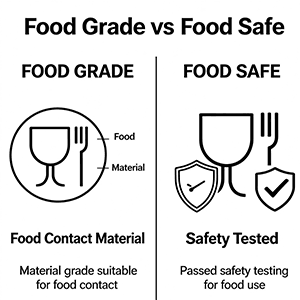
The extra ring matches the difference in meaning. Food grade vs food safe is a question of what is being judged. Food grade describes the material. Food safe describes the finished product, after it has been tested for the way it will really be used.
| Food Grade | Food Safe |
|---|---|
| Icon: Glass-and-fork symbol with “FOOD GRADE” below | Icon: Glass-and-fork symbol inside a ring reading “SAFETY TESTED SAFE FOR FOOD USE” |
| What it describes: The raw material (resin, steel, silicone) | What it describes: The finished product in real use |
| Question it answers: Is this material allowed to touch food? | Question it answers: Does this product stay safe when it is used and cleaned? |
| Evidence: Material declaration; ingredients permitted under FDA or EU rules | Evidence: Migration test report on the finished item |
| Where it can fail: Wrong grade, unlisted additives | Where it can fail: Colorant, mold release agent, heat, long storage, cleaning |
A typical case: a silicone compound is food grade, but the factory colors it with a pigment that is not permitted for food contact. The material is food grade, yet the finished spatula is not food safe. This is why one certificate is rarely enough, and why it is better to ask for both.
The glass-and-fork symbol is also the official EU mark for food contact, set out under Regulation (EC) No 1935/2004. The words “food grade” and “food safe” placed around it are a labelling habit, not a legal category, so the documents behind the icon matter more than the icon.
The food contact surfaces definition most people work from comes from the US FDA Food Code. It covers any surface that food normally touches, plus surfaces that food can drip, drain or splash from onto other surfaces that touch food. So what is a food contact surface is a wider question than it looks. The underside of a lid counts, because steam condenses there and drips back into the container.
Good food contact surfaces that retain their existing qualities stay smooth, non-porous and easy to clean. They do not corrode, flake or absorb liquid, and they keep those properties through normal use, washing and sanitizing. A surface that pits, cracks or sheds particles after a few months fails this test even if it passed on day one.
Direct food contact means the material touches the food itself, such as the inside of a bottle, a silicone baking mat or a kitchen tool. Indirect contact means it does not, but substances could still pass into the food, as with a printed carton around a wrapped snack.
Direct contact usually brings stricter requirements. The EU treats both direct and indirect contact as food contact, and the framework rules apply to both, so the outer packaging is not automatically exempt.
A material counts as a food contact material for two reasons. First, its ingredients are on the permitted lists. Second, it behaves well in practice: it is stable, non-porous, releases very little into food, and survives heat and washing. The four materials below meet both tests for most everyday uses.
| Material | US rule (FDA) | EU rule | Why it suits food contact | Typical products | Watch-outs |
|---|---|---|---|---|---|
| PP | 21 CFR 177.1520 (olefin polymers) | Regulation (EU) No 10/2011 | Non-porous, low migration, resists fats, acids and washing, typically stable up to about 100°C | Containers, lids, kitchen tools (such as a chicken shredder tool) | Not for open flame or very high heat; colorants must be permitted |
| ABS | 21 CFR 177.1020 (ABS copolymer) | Regulation (EU) No 10/2011 | Rigid, tough, holds its shape | Handles, tool bodies, housings (such as a lazy susan for refrigerator) | Typically about 80°C maximum; not ideal for long contact with hot, fatty or acidic food; residual monomers are limited |
| PC | 21 CFR 177.1580 (polycarbonate resins) | Regulation (EU) No 10/2011 | Clear, impact resistant, typically stable up to about 120°C | Tumblers, clear containers | BPA is restricted in the EU, so check current rules |
| Silicone | 21 CFR 177.2600 (rubber articles for repeated use) | No EU-wide specific measure; Regulation (EC) No 1935/2004 plus national rules such as Germany’s BfR | Flexible, non-porous, typically stable from about -40°C to 230°C | Baking mats, spatulas, seals, and parts like a silicone water bottle spout | Fillers and curing method vary between products, so a test report matters |
A few notes on reading the table. In the EU, plastics have a detailed specific measure (Regulation (EU) No 10/2011), which includes a list of permitted substances and migration limits. Silicone does not have one at EU level, so manufacturers rely on the general rule plus national guidance, such as the BfR recommendation in Germany. That makes a test report on the finished silicone product more important than it is for plastics.
The temperatures are typical values, not guarantees. A specific grade, filler or colorant can change them, so confirm against the material data sheet.
At our factory in Yiwu, these are the same four materials we mold every day. Which one is right depends on the product and how it will be used, and the grade and colorant matter as much as the material name.
The FDA does not approve plastic as a finished material. It regulates the substances used to make it. Each substance must be listed in the food additive regulations in 21 CFR, be covered by a Food Contact Notification, or qualify for an exemption, as outlined in official guidelines on FDA: Understanding How the FDA Regulates Substances that Come into Contact with Food. Furthermore, manufacturers submit data through a FDA: Packaging & Food Contact Substances (FCS) framework. The regulations also set conditions of use, such as the food types the material may touch and the maximum temperature.
So when you see FDA approved plastics or FDA compliant plastic parts, what it should mean is that the plastic is made from permitted ingredients and used within those conditions. A supplier who is being precise will name the resin, the relevant regulation and the intended use. A supplier who only says “FDA approved” has told you very little.
For food grade metal parts, stainless steel is the usual choice. Grade 304 is the most common and works for most foods. Grade 316 contains molybdenum and resists chlorides and salty or acidic conditions better, so it is used where food is more corrosive.
Bare aluminum and copper are different. Acidic foods such as tomatoes and citrus can react with them and release metal into the food, so these metals are normally anodized, coated or lined for food use. The point to check is the surface that actually touches the food, not only the base metal.
Food safe glass is among the most stable food contact materials because it is so inert. It does not absorb flavors, and it does not react with acidic food. Borosilicate glass adds good resistance to sudden temperature changes.
The weak points are usually around the glass rather than in it. Painted or decorated exteriors, colored rims and glazes can contain lead or cadmium, which are regulated. Lids, gaskets and seals are often plastic or silicone and need their own documentation. As long as decoration stays clear of the food contact area, glass is a very safe choice.
Non-food packaging is made without food contact rules in mind. The inks, coatings, recycled content and processing aids have not been checked for migration. That is fine for a phone case box, but it should not be reused to hold food, and it should not be treated as packaging that has been accepted for food use.
Adhesives in food packaging hold cartons, labels and laminated pouches together. Most of the time the glue sits behind a barrier layer and never touches the food, which is indirect contact. The FDA covers adhesive components under 21 CFR 175.105.
Direct food contact adhesives are rare and more tightly controlled. There is also no FDA approved glue for direct food contact in the sense of a product approval. What matters is that the adhesive’s ingredients are permitted for how and where it is used. If a supplier says their glue is food safe, ask where it sits in the package and for the compliance documents.
Food contact coatings are used on the inside of metal cans, on non-stick cookware and on coated paperboard. In the US, resinous and polymeric coatings are covered by 21 CFR 175.300.
The classic example is the epoxy lining in cans. These coatings used bisphenol A diglycidyl ether, and that is a big part of why BPA became a food safety topic. A coating has to meet the rules in its own right. It cannot rely on the safety of the material underneath, so a coated product needs documents for the coating as well as for the base.
Food contact materials testing mainly measures migration, which is how much of a material moves into food. A lab fills or soaks the product with food simulants, such as dilute acetic acid for acidic food, ethanol for alcoholic food and vegetable oil for fatty food, then measures what comes out. In the EU, plastics have an overall migration limit of 10 mg per dm² of surface and specific limits for individual substances, such as those outlined in Regulation (EU) No 10/2011.
Labs also look for non-intentionally added substances, such as breakdown products and impurities, which come from processing rather than from the recipe.
Two practical points make a report useful. It should name the actual product or material you are buying, not a similar one. And the test conditions should match real use, such as hot filling, microwave heating or long storage.
Packaging approval should mean you have seen the paperwork, not just heard a promise. Before you accept a food contact product or packaging, ask for:
For plastics sold in the EU, a written declaration of conformity is a legal requirement under Regulation (EU) No 10/2011. Supplier documents that are vague on any of these points are worth questioning.
The framework rule in the EU is Regulation (EC) No 1935/2004, which applies to all food contact materials. Good manufacturing practice is covered by Regulation (EC) No 2023/2006, and plastics have the more detailed Regulation (EU) No 10/2011. Furthermore, substance safety evaluations and scientific risk assessments are coordinated through bodies like EFSA: Food contact materials.
The consequences of non-compliance with EU food packaging regulations depend on the country, since each member state enforces the rules. Typical outcomes are goods held at the border, withdrawal or recall from the market, and fines. Alerts can also be shared between countries, so a problem found in one market can follow a product into others.
Food grade vs food safe: which one matters more?
Both do. Food grade tells you the material is suitable. Food safe tells you the finished product is safe for the way it will be used. Ask for documents covering each.
FDA approved plastics: is that a real thing?
Not exactly. The FDA doesn’t approve plastic itself. It regulates the substances used to make it. A better phrase is “complies with FDA food contact regulations,” with the resin and conditions of use named.
What is a food contact surface?
It is any surface food normally touches, plus surfaces food can drip, drain or splash from onto other surfaces that touch food. That includes inner lids and container sides, not only the base.
Is food safe glass always safe?
Plain glass is very stable. Check decorations, colored rims, lids and seals, since those are where problems usually come from.
How does food contact materials testing work?
A lab exposes the product to food simulants under conditions that match real use, then measures what migrates. Make sure the report covers your exact product and market.
No account yet?
Create an Account