




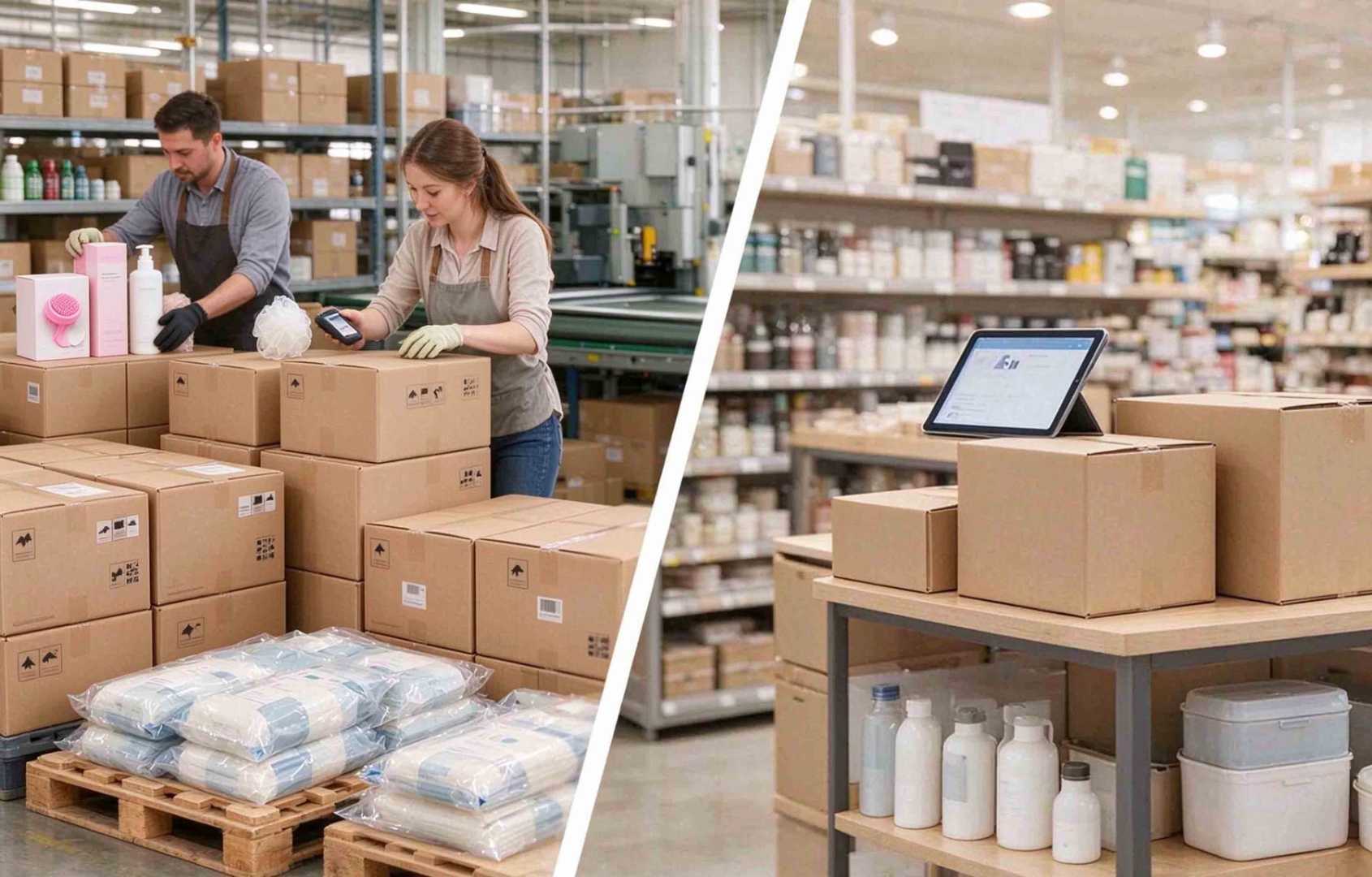
Private label manufacturing is a business model in which a third-party manufacturer produces products that another company sells under its own brand name.
Instead of building a factory or managing production independently, businesses work with established manufacturers to source products, customize designs, apply logos, and develop branded packaging.
For example, a retailer may purchase plastic kitchen utensils from a manufacturer, customize their colors and packaging, and sell them under its own brand.
The manufacturer handles production, while the brand owner focuses on marketing, distribution, and customer relationships.
A private brand refers to the brand owned by the retailer or business, while private labeling describes the arrangement through which products are manufactured and sold under that brand.
Private label production generally involves six steps.
Step 1: Identify Your Product and Market
Research your target customers, competitors, expected selling prices, and product requirements before contacting suppliers.
Step 2: Find a Private Label Manufacturer
Look for manufacturers with relevant production experience, customization capabilities, quality control systems, and suitable MOQs.
Step 3: Select or Customize Products
Businesses can choose existing products or request modifications such as different colors, dimensions, materials, logos, and packaging. For more complex projects, manufacturers may also support product design, prototyping, mold development, and injection molding.
Step 4: Approve Samples
Evaluate product dimensions, materials, functionality, appearance, and packaging before approving mass production.
Step 5: Confirm Pricing and Production
Agree on unit prices, tooling costs, minimum order quantities, production schedules, payment terms, and inspection requirements.
Step 6: Packaging and Delivery
After production and quality inspection, products are labeled, packed, and prepared for shipment according to the agreed requirements.
Private labeling is common in consumer goods, household products, personal care, and many other industries.
| Product Category | Private Label Examples |
|---|---|
| Kitchen tools | Vegetable peelers, graters, knife sharpeners, utensils, Pickle Grabber |
| Household & lifestyle products | Plastic organizers, cleaning tools, storage accessories, Portable Cigarette Case |
| Bathroom accessories | Hair catchers, cleaning brushes, odor-control accessories |
| Baby care | Baby-care accessories and selected first-aid products |
| Personal care & jewelry tools | Grooming tools, brushes, accessories, Ring Sizer |
Plastic household and consumer products are particularly suitable for customization because manufacturers can modify product colors, shapes, dimensions, materials, and surface finishes. Whether you are customizing a specialized kitchen tool like a Pickle Grabber, everyday carry items such as a Portable Cigarette Case, or sizing accessories like a Ring Sizer, injection molding offers flexible branding options.
For example, a retailer may differentiate a standard kitchen gadget through an ergonomic handle, a unique color combination, a custom logo, and retail packaging. These changes can help create a recognizable product line without developing every product from scratch.
These terms describe different levels of manufacturing and product customization.
| Model | Main Characteristics |
|---|---|
| Private Label | Products are sold under the buyer's own brand |
| White Label | Standardized products are sold by multiple brands with different branding |
| OEM | Manufacturing follows the buyer's specifications or designs |
| ODM | The manufacturer provides product design and development services |
Private labeling is suitable for businesses that want to establish their own brands using existing manufacturing resources.
OEM is more appropriate when buyers have specific technical requirements or product designs.
ODM is useful when buyers need support developing new products.
Some manufacturers offer all these services, allowing businesses to expand from standard private label products to more customized product development.
Advantages
Disadvantages
Understanding these challenges before placing an order can help businesses manage costs and reduce risks.
Packaging plays an important role in private branding. It protects products during transportation while communicating brand identity and product information.
Common private label packaging options include:
Private Label Logo and Labeling in Manufacturing
Logo customization can be achieved through screen printing, pad printing, laser engraving, molded-in logos, or adhesive labels.
The appropriate method depends on the product material, surface shape, durability requirements, and order quantity.
Before production, confirm logo size, placement, colors, and artwork. For packaging for private label products, businesses should also consider barcode requirements, product instructions, warnings, and market-specific labeling regulations.
Choosing a reliable private brand manufacturer requires evaluating more than the quoted unit price. Consider these five factors:
For example, manufacturers such as Yiwu Daqida Plastic Products Co., Ltd. offer plastic household product manufacturing and customization services, including product branding and related production support.
Q1. What are some private label examples?
Common examples include kitchen utensils, plastic household products, bathroom accessories, personal care tools, and selected baby-care products.
Q2. Is private label manufacturing profitable?
It can be profitable when businesses select products with sufficient market demand, competitive production costs, and clear brand differentiation. Actual profitability depends on sourcing, marketing, logistics, and sales performance.
Q3. What is the difference between private label and white label?
Private label products may involve customized features and branding, while white label products are generally standardized items sold by multiple businesses under different brand names.
Q4. What is a private label agreement?
A private label agreement defines the responsibilities of the buyer and manufacturer, including product specifications, pricing, quality requirements, branding rights, intellectual property, and delivery terms.
Q5. Can I customize products with my own logo and packaging?
Yes. Many manufacturers offer logo printing, custom colors, retail boxes, labels, and other packaging solutions. Available options depend on the product and order quantity.
Q6. Can a private label manufacturer develop a completely new product?
Some manufacturers offer product development services, including design evaluation, prototyping, mold development, and mass production. Buyers should confirm these capabilities before starting a project.
Q7. Who owns the mold in private label manufacturing?
Mold ownership depends on the agreement between the buyer and manufacturer. If the buyer pays for custom tooling, ownership, storage, maintenance, and authorized usage should be clearly defined in writing.
Q8. What is the typical MOQ for private label products?
There is no universal MOQ. It depends on product type, customization requirements, packaging, materials, and production processes. Existing products with logo customization may have different MOQs from completely new products.
Private label manufacturing gives businesses an opportunity to build their own product brands without establishing independent manufacturing operations.
However, successful private labeling requires more than choosing a product and adding a logo. Product quality, supplier capabilities, customization options, packaging, production costs, and long-term cooperation all matter.
By evaluating these factors carefully, businesses can develop differentiated products, manage manufacturing risks, and build sustainable product lines.
No account yet?
Create an Account