



For B2B buyers sourcing bulk household goods, the wooden vs. plastic pants hanger decision affects landed cost, brand perception, and long-term replacement frequency. This guide compares both options across durability, unit economics, sustainability, and manufacturing scalability, with data tables designed for procurement teams evaluating injection molding suppliers and wooden hanger manufacturers.
Wooden pant hangers are produced through carpentry processes: timber selection, cutting, shaping, sanding, surface finishing, and hardware assembly. Hardwoods such as beech, lotus wood, and schima are standard for load-bearing pant hangers, offering high strength and minimal deformation under load. Production is labor-intensive and timber-dependent, which limits design flexibility compared to molded alternatives.
Plastic pants hangers are manufactured via injection molding using polypropylene (PP), polystyrene (PS), or ABS. PP is the low-cost workhorse for everyday hangers, handling 6–8 lbs with good flexibility and moisture resistance. ABS is denser and more rigid, rated for 10–12 lbs, making it suitable for heavy trousers and structured garments. PS offers transparency for retail display but is brittle and prone to snapping under load or in cold shipping temperatures. Multi-cavity molds with hot runner systems allow cycle times optimized for high-volume output, which is essential when molding millions of units.
| Property | Wooden Hanger (Beech/Lotus) | PP Plastic Hanger | ABS Plastic Hanger | PS Plastic Hanger |
|---|---|---|---|---|
| Typical weight | 80–120 g | 25–30 g | 35–50 g | 28–35 g |
| Load capacity | 10+ lbs | 6–8 lbs | 10–12 lbs | 3–5 lbs |
| Moisture resistance | Low (warps when wet) | High | High | Moderate |
| Temperature sensitivity | Low | Low | Moderate | High (brittle when cold) |
| Surface finish options | Stain, lacquer, paint | Matte, gloss, flocked | Matte, gloss, chrome-plated | Transparent, frosted |
| Design flexibility | Limited to machining | High (complex geometry) | High | High |
Durability is where the two materials diverge most sharply. Comparative studies indicate wooden coat hangers exhibit higher strength and a lower deformation index than plastic equivalents under sustained load. Wooden pant hangers from solid hardwood routinely last 10+ years in retail environments, reducing replacement frequency for garment factories and retail chains. However, wood hangers can warp when subjected to damp clothing, and prolonged exposure to humid environments may cause cracking or finish damage.
Plastic hangers have a shorter service life — typically 3–5 years under normal retail conditions. Standard plastic pant hangers are rated for 1–1.5 kg (2–3 lbs), sufficient for chinos and dress slacks but marginal for dry denim, which sits at the upper edge of that range. Heavier styles with solid ABS arms at least 2 mm thick and spring-loaded serrated rubber clips can handle denim and structured trousers, with some tested designs exceeding 2 kg without deformation.
| Metric | Wooden Hanger | Basic Plastic Hanger | Heavy-Duty Plastic (ABS) |
|---|---|---|---|
| Static load capacity | 10–14 lbs | 2–3 lbs | 4–6 lbs |
| Clip pull-out capacity (VICS standard) | N/A (bar design) | 4.0–4.8 lbs (8"–12") | 4.0–4.8 lbs |
| Expected lifespan (retail use) | 10+ years | 3–5 years | 3–5 years |
| Deformation under sustained load | Minimal | Moderate to high | Low |
| Failure mode | Clip hardware fatigue | Arm bowing, clip grip loss | Clip wear, hook wobble |
VICS/GS1 standards specify minimum fabric pull-out capacity of 4.0 lbs for 8"–12" short pad bottom hangers and 4.8 lbs for long pad versions, tested by simulating a garment being pulled from the hanger pad. Buyers should require test reports against these standards rather than relying on supplier marketing claims.
Upfront unit cost strongly favors plastic. Wooden pant hangers typically range from $0.45 to $0.68 per unit at wholesale, with premium hardwood and custom-finished versions exceeding $1.00. Injection-molded plastic hangers start as low as $0.14–$0.25 per unit for standard designs, with ABS clip models at $0.60–$0.75 and basic plastic hangers at $0.14–$0.18 per piece.
The cost gap narrows when total cost of ownership is considered. Wooden hangers reduce replacement frequency, lowering annual procurement volume. For a retail chain managing 10,000 hangers across multiple stores, a plastic hanger replaced every 3 years costs approximately $0.05–$0.08 per unit per year in replacement procurement. A wooden hanger at $0.55 with a 10-year lifespan costs roughly $0.055 per unit per year — essentially equivalent in amortized terms.
| Cost Factor | Wooden Hanger | Plastic Hanger (PP) | Plastic Hanger (ABS) |
|---|---|---|---|
| Unit price (1,000–5,000 pcs) | $0.45–$0.68 | $0.14–$0.25 | $0.60–$0.75 |
| Minimum order quantity | 100–2,000 pcs | 300–1,000 pcs | 500–1,000 pcs |
| Tooling / mold cost | None (standard designs) | $500–$3,000 (aluminum) | $3,000–$10,000+ (steel) |
| Custom logo cost | $0.05–$0.15/unit (engraving) | $0.01–$0.05/unit (silk screen) | $0.02–$0.08/unit (pad print) |
| Freight weight impact (per 10,000 pcs) | 800–1,200 kg | 250–300 kg | 350–500 kg |
| 5-year TCO (10,000 units, retail) | $5,500–$6,800 | $1,800–$3,200 (includes 1 replacement cycle) | $7,500–$9,500 |
The MOQ difference is significant for smaller buyers. Wooden hangers from Chinese factories often carry MOQs of 100–2,000 pieces depending on customization level. Plastic hangers from injection molding factories typically start at 300–1,000 pieces for standard designs, but custom mold programs push entry volumes to 3,000+ pieces to amortize tooling. For a startup brand testing a new SKU, wooden hangers offer a lower-risk entry point because no tooling investment is required.
Wooden hangers carry a sustainability advantage — they are renewable, 100% recyclable, and offer a premium eco-positioning. However, FSC certification is non-negotiable for EU market entry. From January 2025, all wooden products entering the EU must comply with the EU Deforestation Regulation (EUDR), requiring proof of sustainable sourcing and traceability documentation. Suppliers should provide FSC Chain of Custody certification and EUDR readiness documentation.
Plastic hangers face sustainability scrutiny but offer a different compliance path. Recycled PP and mono-material designs reduce environmental impact, and some brands now specify recycled content in their procurement specs. For plastic hangers, RoHS compliance is the baseline requirement for electronic-adjacent markets, and REACH compliance is essential for EU sales. PS hangers should be avoided for cold-chain shipping due to brittleness.
| Requirement | Wooden Hanger | Plastic Hanger (PP/ABS) |
|---|---|---|
| EU market entry | FSC + EUDR documentation | REACH + RoHS compliance |
| Recyclability | 100% recyclable | Recyclable (PP mono-material best) |
| Renewable material | Yes | No (unless bio-based PP) |
| Carbon footprint (per unit) | Higher (labor + transport intensive) | Lower (automated, lightweight) |
| Certifications available | FSC, PEFC, SMETA | GRS (recycled), ISO 9001 |
| Cold shipping performance | Good | PP/ABS good; PS poor |
Wooden hangers offer superior branding potential through engraving, laser etching, and high-quality surface finishes. The tactile experience of a solid wood hanger reinforces premium positioning — a critical factor for high-end homeware stores and luxury apparel brands. Custom shapes and profiles are possible but require dedicated carpentry setups, increasing MOQ and lead time.
Plastic hangers excel in functional customization: color matching to Pantone standards, logo silk-screening or pad printing, flocked surfaces for non-slip properties, and complex geometry that would be impractical in wood. Injection molding allows rapid iteration on clip design, arm thickness, and hook style without retooling if the base mold accommodates the variation. A plastic hanger can be produced in multiple colors from the same mold using color masterbatch changes — a flexibility that wooden hangers cannot match.
There is no universal winner. Plastic pants hangers win on unit cost, weight, design flexibility, and scalability — the default for mass-market retail and e-commerce. Wooden pant hangers win on durability, premium perception, and sustainability positioning — the default for luxury brands and high-end retail channels. For most bulk household goods programs, the optimal strategy is a dual-track approach: plastic hangers for volume SKUs and standard retail, wooden hangers for premium collections and brand-building displays.
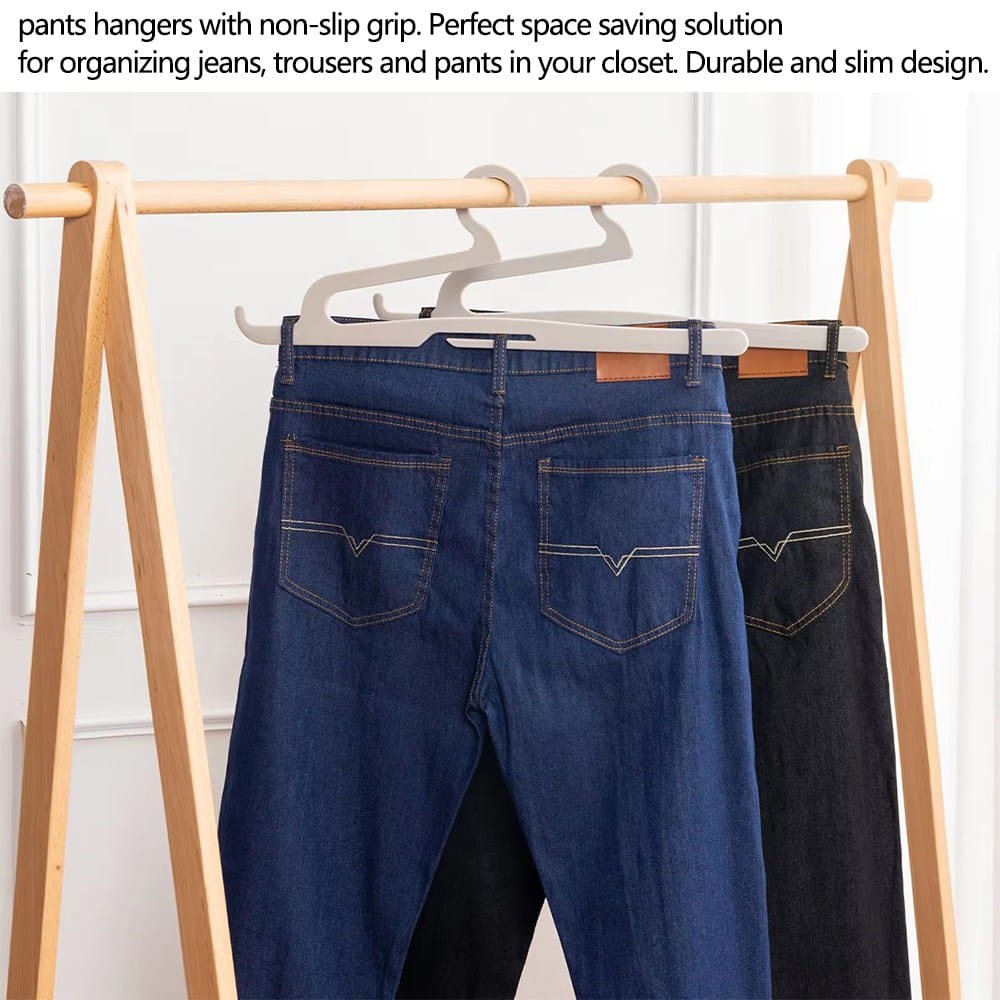
Ready to source custom plastic hangers, including options like our Space Saving Non-Slip Denim & Pants Hanger? Contact our injection molding team for MOQ options, mold cost estimates, and OEM/ODM program details.
Q1: What is the difference between a wooden pant hanger and plastic pants hangers?
Wooden pant hangers offer a premium feel, higher load capacity, and longer service life. Plastic pants hangers are lighter, more affordable, and easier to customize for bulk household goods.
Q2: Are pants clip hangers better than a wooden hanger with clips for bulk household goods?
It depends on your sales channel. Plastic pants clip hangers are more cost-effective and scalable for mass retail. A wooden hanger with clips offers stronger brand perception and durability, but at a higher unit cost.
Q3: What is the MOQ for pants skirt hangers, plastic pants hangers, and heavy duty pant hangers?
Standard plastic pants hangers and pants skirt hangers usually start at 300–1,000 pcs. Heavy duty pant hangers with reinforced clips may require 500–1,000 pcs. Custom molds typically need 3,000+ pcs.
Q4: Can I customize hangers with clips for pants, black pants hanger, and black trouser hangers?
Yes. We support OEM/ODM for hangers with clips for pants, including black pants hanger, black trouser hangers, white plastic hangers with clips, and clear hangers. Custom logo, Pantone color matching, flocked surface, and retail packaging are available.
Q5: Do you offer plastic hangers with clips and white plastic hangers with clips for supermarkets?
Yes. These are widely used for supermarket and retail display. We can add size dividers, hanger size markers, barcode labels, and shelf-ready packaging for commercial hanger programs.
No account yet?
Create an Account